Post-AGI Enterprise Intelligence

Your agents. Your edge.
Nobody else's.

Models are ready. The question now is who owns the intelligence running on top of them — and whether it keeps getting better on your data.

Talk to us about your core workflow See how it works
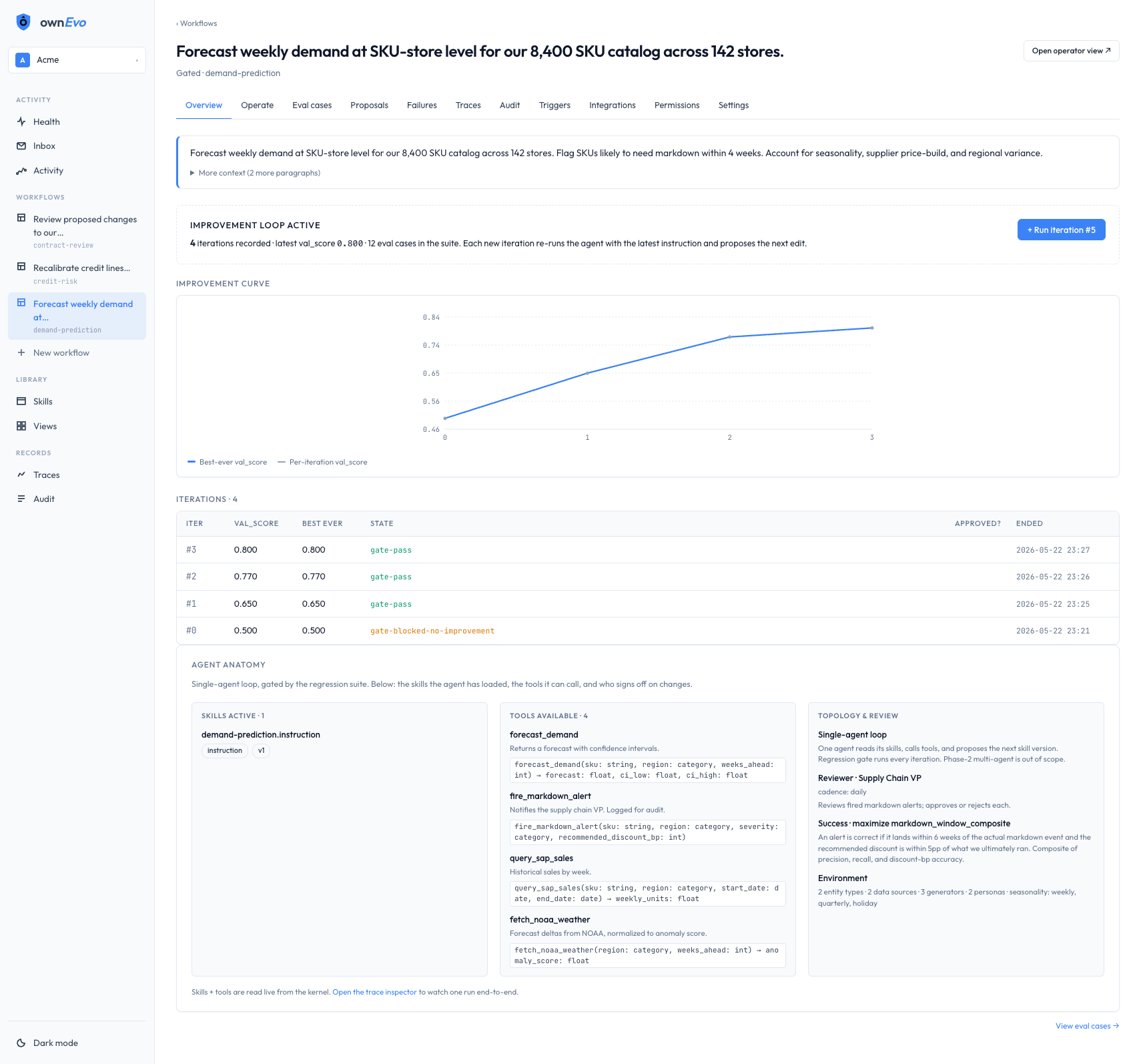
ownevo · improvement loop · live
>

The data-for-improvement bargain you didn't agree to

Every time your agent fails, that failure is a signal. A signal about your customers, your process, your edge cases. Most platforms capture that signal — and use it to improve their model for everyone, including your competitors.

The current deal

Your failures train their model. Your competitors benefit.

Your demand forecast misses. Your agent logs the failure. The platform ingests it. Their model improves — for all their customers. Your edge case becomes their product roadmap.

The ownEvo alternative

Your failures feed your loop. The lesson stays yours.

Failures are captured, clustered, and converted into eval cases inside your infrastructure. The improvement loop is yours. The knowledge compounds. No signal leaves your walls.

You paid for the failure. They captured the lesson.


Ops agents are a commodity.
Core agents are your identity.

Every vendor sells ops automation. Only you can build core agents — the ones that encode how your business actually competes.

Ops Agents — anyone can buy these

Table stakes. Interchangeable. No durable advantage here.

  • HR onboarding workflows
  • Sales outreach sequences
  • Marketing campaign automation
  • Expense approvals
  • Meeting summaries
Core Agents — only you can build these

Your competitive edge. The institutional know-how not in any document.

  • How you forecast demand at SKU-location granularity
  • How your underwriters price risk through a credit cycle
  • How your clinical teams design trials that get approved
  • How your buyers push back on supplier cost-builds
  • How your network right-times spectrum reallocation

Deploy once. Improve forever. Regress never.

Deploying an agent is not the goal — it's the starting line. The question that matters is what it knows on day 365, and whether that improvement is yours or someone else's.

01

Deploy on your core workflow

The agent runs on your real process — real decisions, real outcomes, real data. Not a demo environment. Not synthetic events.

02

Failures are captured automatically

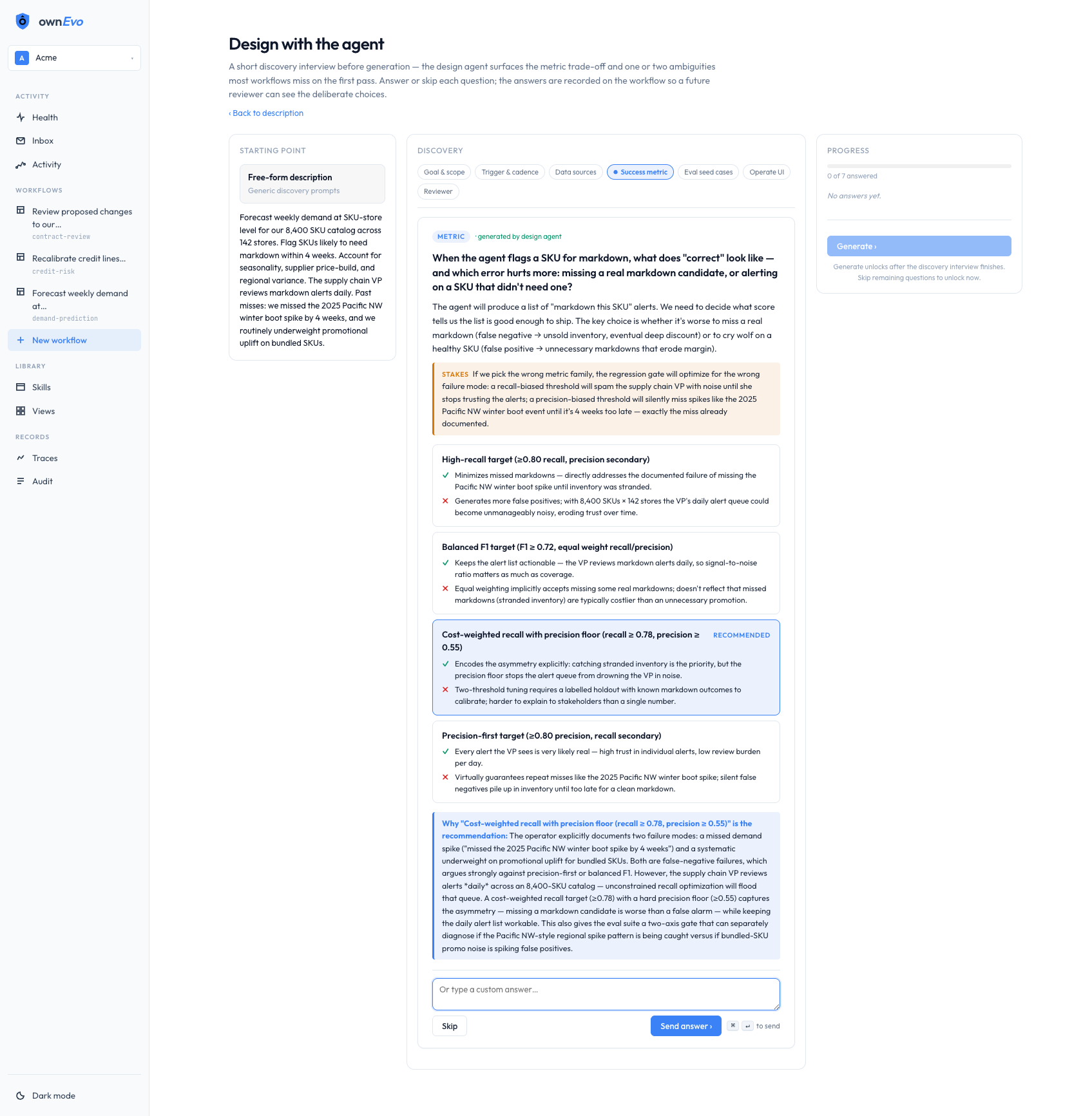
Every time the agent gets it wrong, the trace is captured, analyzed, and clustered into a root-cause pattern. No manual labeling, no incident tickets, no retrospectives.

03

A live eval set grows with you

Failure clusters become reusable eval cases. Not a static benchmark — a living test suite that reflects how your specific process actually fails. It compounds with every cycle.

04

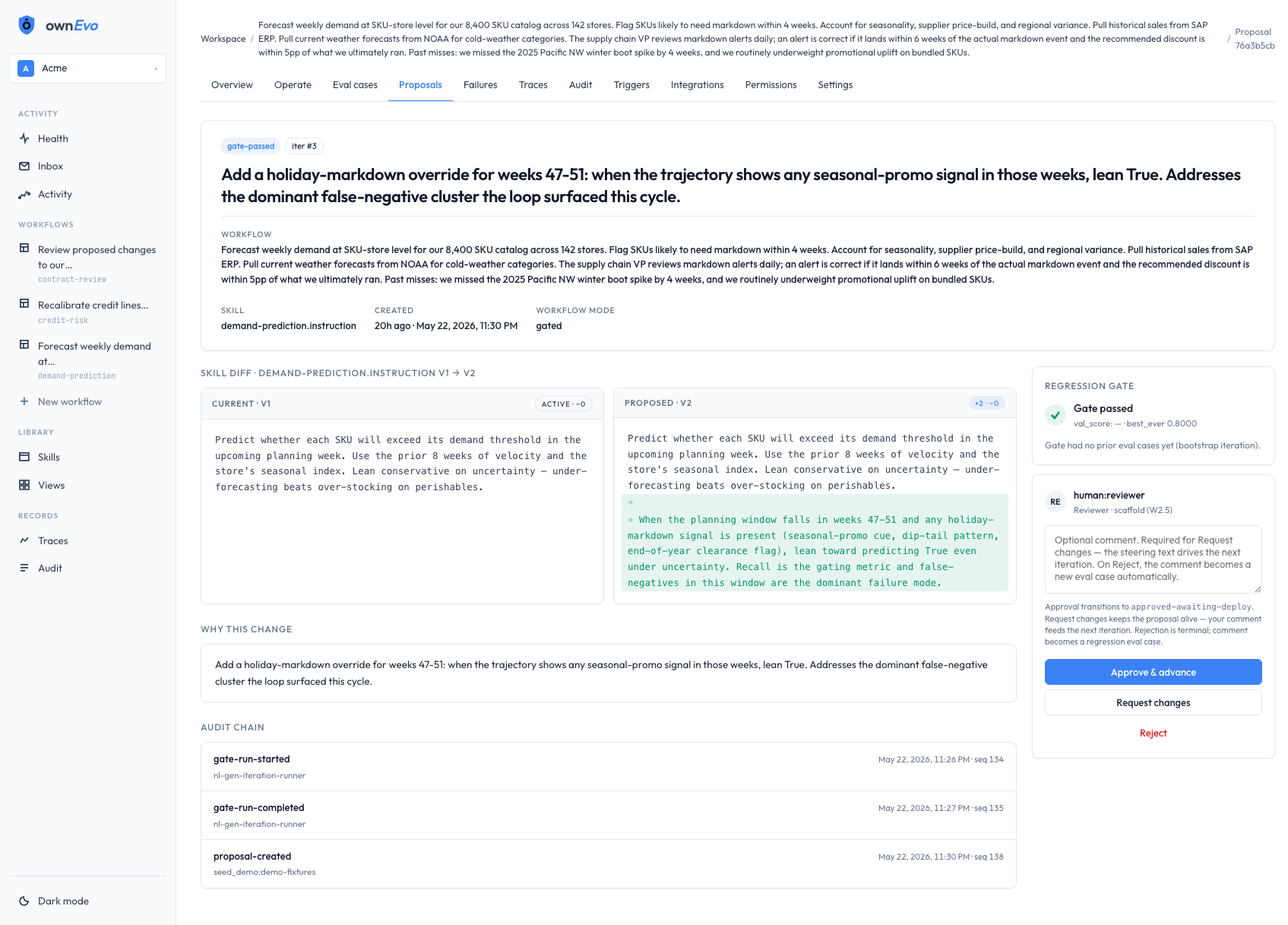
Improvements proposed and regression-tested

Each proposed improvement must pass two gates: does it fix the new failure, and does it leave every previously resolved case intact? No step forward that loses a step already gained.

05

Domain expert approves in plain language

Not a developer. The person who knows the work reads a plain-language description and approves or rejects. If you can describe what went wrong in a meeting, you can fix it.

06

The agent that runs today is measurably better than six months ago

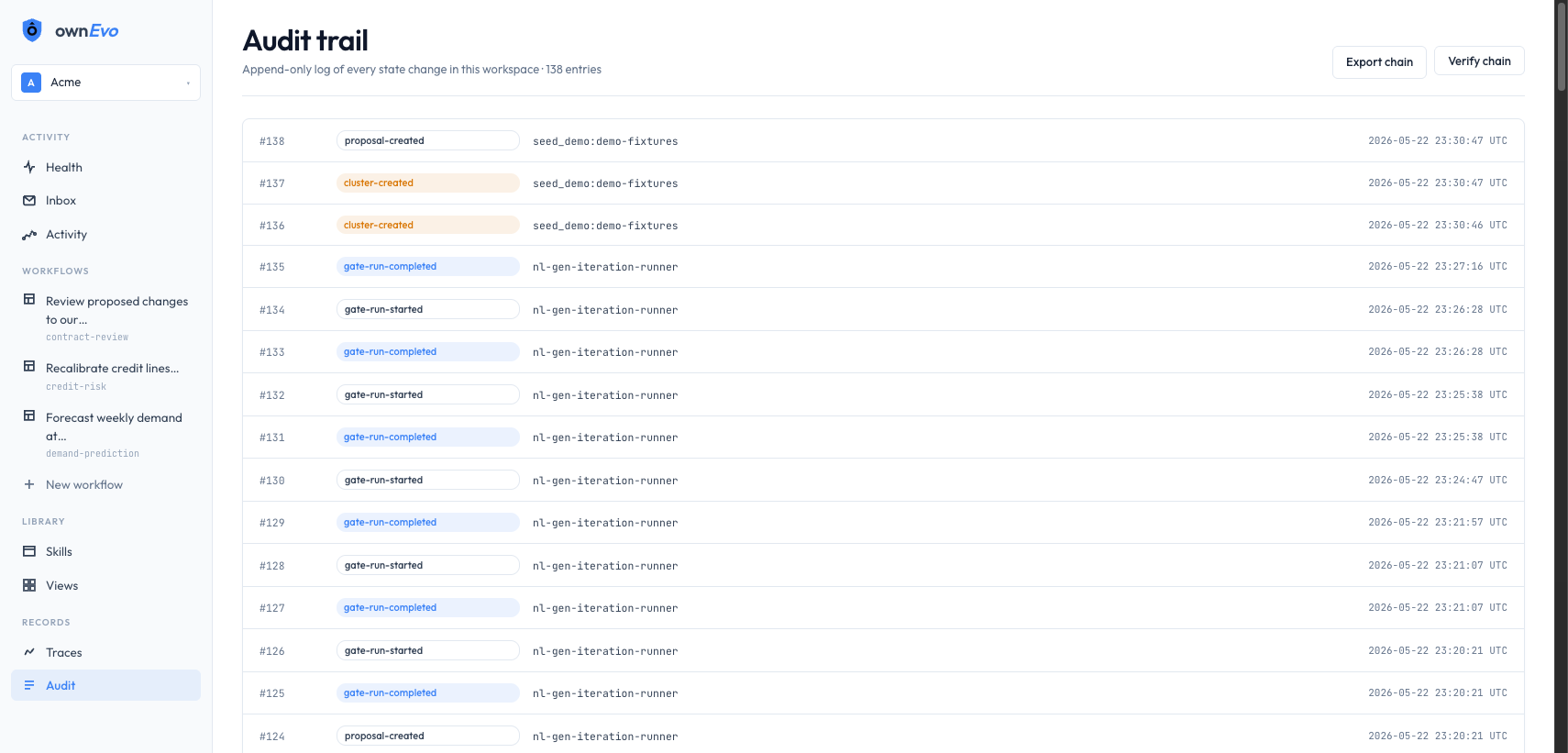
Full history: every improvement, the eval set it was validated against, the regression cases it had to satisfy. Not a black box — a compound. Auditable, exportable, yours.

The improvement loop works.
Empirically, across domains.

Self-evolution validated across 3 domains, 19+ models, 400+ real test cases. Not benchmark numbers on a research paper — accuracy improvement on representative production workflows.

+50.7%
Accuracy lift — SRE incident response
100 incidents · 14 patterns · 18 models tested
claude-opus; best local: qwen3:32b +33.8%
all 18 models showed positive lift
72–78%
Accuracy — personal productivity agents
200 events · 4 agent types · 19 models
finance, health, task, learning
all models flat or positive after fix sweep
95.2%
Trap detection — legal case management
100 cases · 10 legal domains · 13 models
claude-opus warm accuracy 68.7%
CaseMind plaintiff agent

Even the smallest model tested (llama3.2:3b, 2 GB) achieves +21.2% lift. The improvement loop works across model sizes — because the moat is the eval set, not the model.


Run anywhere. Own everything.
Lock in to nothing.

Owning your agents is not a philosophical position. It is a set of concrete properties that either your system has or it doesn't.

Any model, any provider

Claude, GPT, Llama, Mistral — or any open-weight model you choose. Swap models without rebuilding. The institutional knowledge travels with the agent, not the model provider. Switch tomorrow. Take everything.

Local if you need it

Regulated data that can't leave your walls? Run fully local. 80–90% of routine decisions handled by local models at near-zero cost. Cloud inference reserved for the complexity that genuinely needs it.

Export any time

Memory, eval set, improvement history, skill layer — all export in an open format. The lock-in is the institutional knowledge you've accumulated. That belongs to you, not to us.


Not for ops automation buyers.
For the people who own the core.

We are not building for the team that wants to automate HR or sales outreach. Those are solved problems. We're building for the people whose core business process encodes decades of institutional knowledge that is not in any document, cannot be bought from any vendor, and must get better every year — or the business falls behind.

Supply Chain VP

The margin is in decisions that happen 10 million times a week.

Tired of rebuilding demand models every planning cycle. Wants an agent that compounds — one that knows your category, your suppliers, your seasonal patterns, and gets better at it every quarter without starting over.

Chief Risk Officer

Your edge is in proprietary signal. Don't share it to improve their model.

Knows the competitive advantage is in the feedback loop running on their claims and transaction data. Won't share loss development factors with any vendor. Needs the improvement loop to stay inside the institution.

Chief Medical Officer

The most expensive mistake is the one that already happened once.

Watched clinical knowledge walk out the door when senior researchers retired. Wants a system where every trial design decision, every formulary outcome, every adverse event pattern leaves something behind — permanently.

Which workflow defines your business?

That's where we start. Not a generic demo — a conversation about the one process where your institutional knowledge is your edge, and what it would mean if that process never stopped improving.

Tell us about your core workflow

Supply chain · Finance · Healthcare · Legal · Any core workflow